
Faced with the prospect of a tidal wave of Democratic Party losses in the upcoming midterms, the first incoherent President embarked on a mission to pass what he termed the most ‘progressive bill’ since FDR. Slimmed down from the infamous ‘Build Back Better’ bill that featured a series of unfunded spending pledges, the wasteful spending projects and subsidies are now accompanied by job-killing tax hikes. Economists and analysts have already concluded that the bill will do little to suppress inflation; in fact, the outcome could be far worse. A series of supply-side limiting provisions could harm economic growth – exacerbating the inflationary spiral and imposing misery on households.
Provisions
Taxation
15% Corporate Minimum Tax
Drug Pricing Reforms
Elimination of the Carried Interest Loophole
Expenditure
| Spending | Cost (10 Years) |
| Energy & Climate Relief | $369 Billion |
| Expansion of the Affordable Care Act | $64 Billion |
Cost of Living Crisis
Amidst the cost of living crisis, households need the government to rectify the policy mistakes that gave birth to the current inflationary crisis in the first place. Excessive, wasteful spending as the pandemic ravaged the nation gave birth to large budget deficits. The deficit reached over $3 trillion in 2020, falling slightly to $2.7 trillion in 2021. Funded largely through the Federal Reserve monetising government bonds, the result was a surge in the broad money supply, producing consumer price inflation.
To curb inflation, Biden needed to cut the budget deficit and slow increases in the money supply, all the while ensuring the private sector funded most deficit spending. While reversing the increase in the money supply would put a sure end to the inflation spiral, it would likely provoke a deep recession. Ensuring a gradual fall in the inflation rate is the optimal solution.
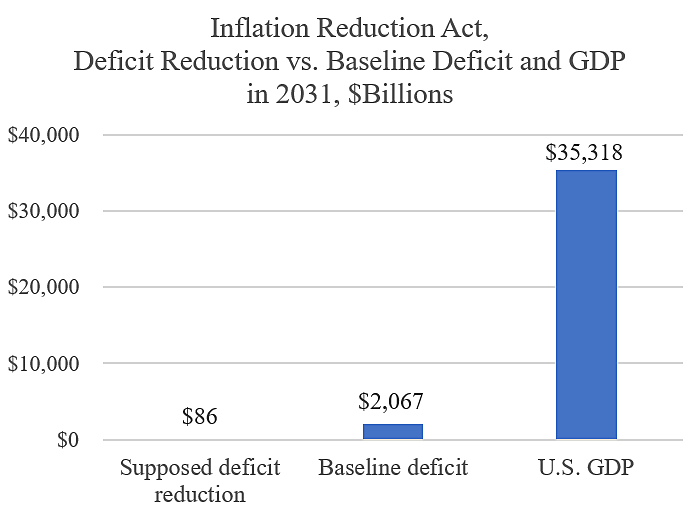
However, forecasts highlight the limited effect on the budget deficit from Biden’s legislative package. A supposed deficit reduction of $86 billion is hardly enough to curb spending.
Parts of Biden’s legislative agenda look to hit the poorest Americans directly. Audits of taxpayers making under $400,000 will account for about $20 billion of the additional revenue from the Inflation Reduction Act. An average of over $130 per worker. This is without accounting for indirect costs on hard-working Americans from the bill.
Gutting Growth
As exists an inverse relationship between long-run sustainable economic growth and inflation, promoting economic growth is vital to alleviate the current inflation crisis. As aforementioned in the previous article with the Quantity Theory of Money, both the Keynesian and Classical Aggregate Supply models illustrate this.
The corporate tax rises on multinational corporations, largely responsible for the sluggish economic recovery from the Great Recession, will have a detrimental impact. A recent study by the OECD rendered corporate taxes the most harmful tax for economic growth and activity – property taxes the least damaging. Obvious for most, Biden’s tax increases at a time of spiralling inflation will stunt the productive potential of the American economy, limiting the ability of economic growth to curb rising prices. A study by the Joint Committee on Taxation uncovered that half of the tax hikes in the bill will fall on manufacturers – a catastrophe for economic output.
Tax increases will also produce greater allocative inefficiency. As the government becomes more responsible for expenditure and allocating resources, information failures and regulatory capture will inevitably produce a misallocation of resources, thereby preventing resources from reaching their most efficient use. Similarly, this constrains the economic potential of the US economy.
While the energy subsidies and climate-related programs are well-intentioned, enabling the private sector to allocate resources to fight climate change would be far more efficient. Politicians, who succumbed to regulatory capture will less efficiently allocate the capital required to tackle the climate emergency, beholden to their select corporate interests. Potentially more efficient renewable energy firms are deprived of capital that would otherwise have been allocated by Venture Capital firms and other investors alike. The subsidised firms under the Inflation Reduction Act would have received private funding in either case, if they appealed to investors as a sustainable investment – rendering a lack of need for intervention in the first place. As a pose to letting the government pick and choose, the private sector will ensure the firms best-placed receive funding to fight the climate emergency, instead of Democratic donors.
A carrot – not a stick approach is needed. The sharp rise of ESG investing and sustainability-linked bonds highlights this. Instead of depriving the private sector of resources to fight climate change effectively through corporate tax increases and regulatory reform, promoting innovation and private-sector investment would ensure greater efficiency and quicker solutions.
Ultimately, the rebranded Build Back Better bill fails to tackle inflation, leaving the potential for increased inflationary pressure. Previously promising to curb the ballooning budget deficit, projections highlight a minute effect on reducing the tax-spending imbalance – a key cause of the current inflationary spiral. Biden has instead left the door open for a fall in GDP output, through tax increases likely to produce a misallocation of resources to stunt economic activity. No wonder a Republican tsunami in November seems inevitable.

 Free Marketeer