
A common misconception is the attribution of the Great Depression to the failures of Capitalism. Excessive greed from Wall Street Capitalists, artificially inflating the NYSE through speculation, produced an economic calamity – a tale told by Socialists and misguided historians alike. While the Wall Street Crash of 1929 provoked an initial economic contraction, the decline would’ve been mild at best if it hadn’t been for the actions of the Federal Reserve. An economy desperate for stimulus saw the opposite – contractionary monetary measures plunged the US economy from one of growing wealth and prosperity, to what became the Great Depression.
Remarkable Growth


The Roaring Twenties
A time of unparalleled economic growth and prosperity. Thanks to the pro-growth policies of the Republican government, Americans saw a rapid rise in living standards over the course of the decade.
Tax reform was at the forefront of President Coolidge’s agenda. The top tax rate on income above $100,000 was slashed from an astonishing 60% in 1921 to a more competitive rate of 25% by 1925. This sparked a wave of economic growth, spurring private enterprise through an unleash of capital.
As a pose to government bureaucrats wasting taxpayer funds, the private sector allocated resources far more efficiently, promoting strong GDP growth. As a result of such wealth and prosperity generation, the tax reductions increased tax revenues as economic growth sharply rose.
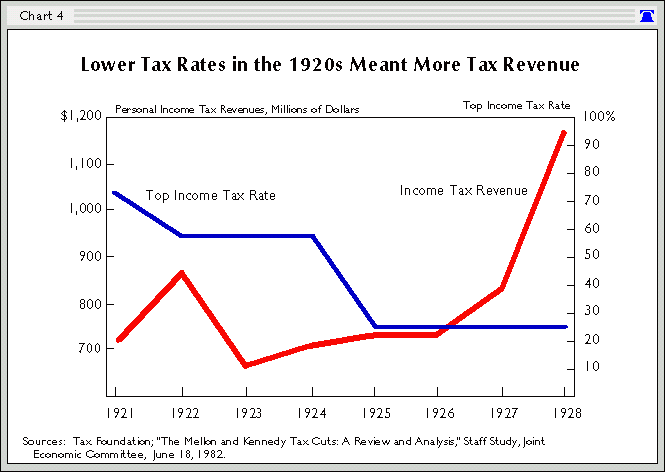
Through the price mechanism, the free market’s ‘invisible hand’ acted according to the preferences of consumers, leading to greater prosperity for Americans. As wealthier individuals have a larger marginal propensity to invest, a sharp increase in investment in the US economy created a productivity boom, subsequently rising employment and income levels with it. The unemployment rate hovered at about 5% for much of the decade.
Role of the Money Supply
Monetary policy shares credit with fiscal policy in creating jobs and prosperity, though it later claims the entirety of the blame in the aftermath. Broad money supply growth remained fairly consistent across the decade, steadily declining from a high of 9% in 1923 to 4% annually by 1928, in line with rising market interest rates. Sustained growth in the money supply provides firms with cheaper credit, by lowering interest rates throughout the economy. Similarly, putting more money in the hands of consumers stimulates spending. Both of these processes lead to business investment, spurring economic growth.
These increases in the money supply correlated with GDP growth during the 1920s, with both the price level and velocity remaining constant. However, sharp increases or falls in the money supply produce inflationary or deflationary pressures, the latter of which was witnessed amidst the Great Depression.
Contraction and Depression
In 1928, the Federal Reserve announced its plan of tightening the money supply to curb the excesses of the speculation in the NYSE. Through tightening, the Federal Reserve hoped to reduce the frequency of borrowing to ‘invest’ in the stock market, driving a huge surge in consumer debt. By late 1929, the discount rate was raised from 5% to 6%. Similarly, broad money supply growth turned negative as the M2 money stock started to decline for the first time since the turn of the decade.
However, these contractionary measures came at a time of economic stagnation. In October 1929, the stock market bubble popped, leaving investors fearful and wiping out retirement savings in a matter of days. As a result, the Federal Reserve needed to increase the money supply and pump much needed liquidity into the markets to reassure investors.
Unfortunately, the Federal Reserve took disastrous measures; contracting the money supply and increasing the discount and federal funds rate at a time of economic decline. The Central Bank continued to restrict the money supply, increasing interest rates by 200 basis points in late 1931. What followed was a sharp contraction in industrial output, as currency hoarding soared from greater uncertainty and a lack of deposit insurance. Provoking a bank run, the tight money policies of the Federal Reserve decimated the financial system, leaving the US economy in depression.
Ultimately, poor monetary policy by the Federal Reserve provoked the calamity that became the Great Depression. A decade of unparalleled economic growth, driven by the success of prudent fiscal policy and stable monetary policy, was wiped out at the hands of the Federal Reserve. Restricting the money supply and raising interest rates deprived the market of much-needed liquidity. The Federal Reserve learned its lesson, flooding the financial markets with liquidity amidst the pandemic, not to repeat the mistakes of 1929 and to a lesser extent, 2008. However, the stimulus has been extreme – giving birth to the inflationary spiral witnessed in the 1970s, the result of excessive broad money supply growth.

 Free Marketeer