
One of the wealthiest countries in the world, Switzerland’s economy stands amongst the strongest globally. Through following neo-classical, supply-side economics and rejecting the post-WW2 Keynesian consensus, the Swiss economy has thrived and currently has the second highest income per capita globally (adjusted for PPP).
1990s Stagnation
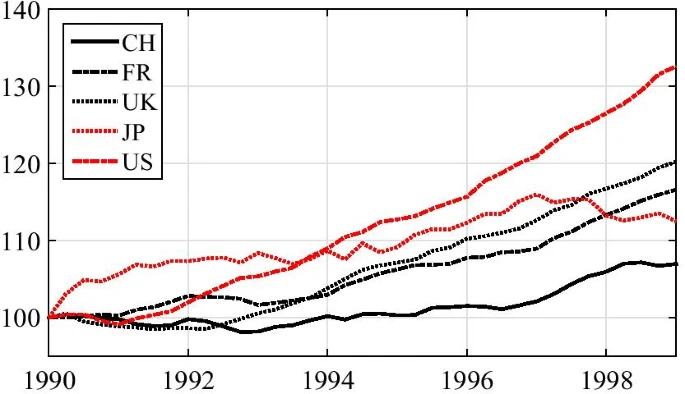
Switzerland’s economic strength hasn’t always been a given. During the 1990s, Switzerland stagnated relative to their Western counterparts. This was due to the struggling supply-side of the economy. Increases in labour income taxes coupled with financial frictions, led to real GDP growth slowing. Similarly, increases in unemployment benefits discouraged work, further limiting the productive potential growth of the Swiss economy.
Whereas Western counterparts were reforming welfare, restricting its provision to the truly needy and promoting those able into work, Switzerland moved in the opposing direction by incentivising individuals to choose welfare over work. The stagnation ended in 1999 with the election of the conservative Swiss People’s Party, returning Switzerland to the successful supply-side policies that ushered in its prosperity in the first place.
Taxation
Switzerland’s prosperity is largely attributable to its monetary stability and limited-government intervention on the fiscal-side. In 2013, government expenditures as a percentage of GDP stood at 34% – far lower than the OECD average of 42%. Similarly, government revenues in Switzerland stood at 34% whereas the OECD average was at 38%. A commitment to stable fiscal policy with a balanced budget inspires business confidence in the Swiss Franc and economy as a whole. In countries such as Greece and Spain, bond yields rocketed following the financial crisis as investors sought safer securities; Switzerland provided an ideal haven due to its fiscal rectitude.
Despite a low tax state, Switzerland’s public spending is highly efficient and isn’t wasteful compared to countries such as the UK. Instead of wasting a large proportion of their budget on transfer payments that add little value to the economy, Swiss fiscal policy promotes infrastructure development that ensures its large private sector can operate efficiently. Public investment as a share of GDP was 10% in 2013, compared to the OECD average of 7%. Switzerland uses its limited state to support and promote private sector activity instead of instigating its own distortionary mechanisms through large government spending that lead to a misallocation of resources and a poorer economy.
Switzerland opted for monetary policy to stimulate aggregate demand growth in the aftermath of 2008. The balance sheet of the Swiss National Bank increased by over 100bn Swiss Franc between 2008 and 2010, thereby stimulating the economy through the excess cash balance mechanism. This kept government spending low, instead of the Keynesian fiscal stimulus that many nations opted for, leading to the private sector driving the economic recovery as a pose to the wasteful public sector.
Ultimately, the small state of Switzerland remains one of the most prosperous globally due to its commitment to supply-side principles. By keeping the government small and the private sector free to allocate resources efficiently, Swiss economic might and prosperity looks set to continue for decades to come.

 Free Marketeer