
Elected in 2017 following the resignation and subsequent jailing of the disgraced Park Geun-hye, Moon Jae-In became the 12th President of South Korea. However, his legacy needs more to be desired. While his administration’s handling of the coronavirus pandemic proved effective relative to other Western economies, spiralling housing and energy costs alongside a slowing domestic economy ultimately culminated in the opposition party’s election following the end of his five-year term.
Housing & Energy
Excessive intervention led to higher costs for consumers.
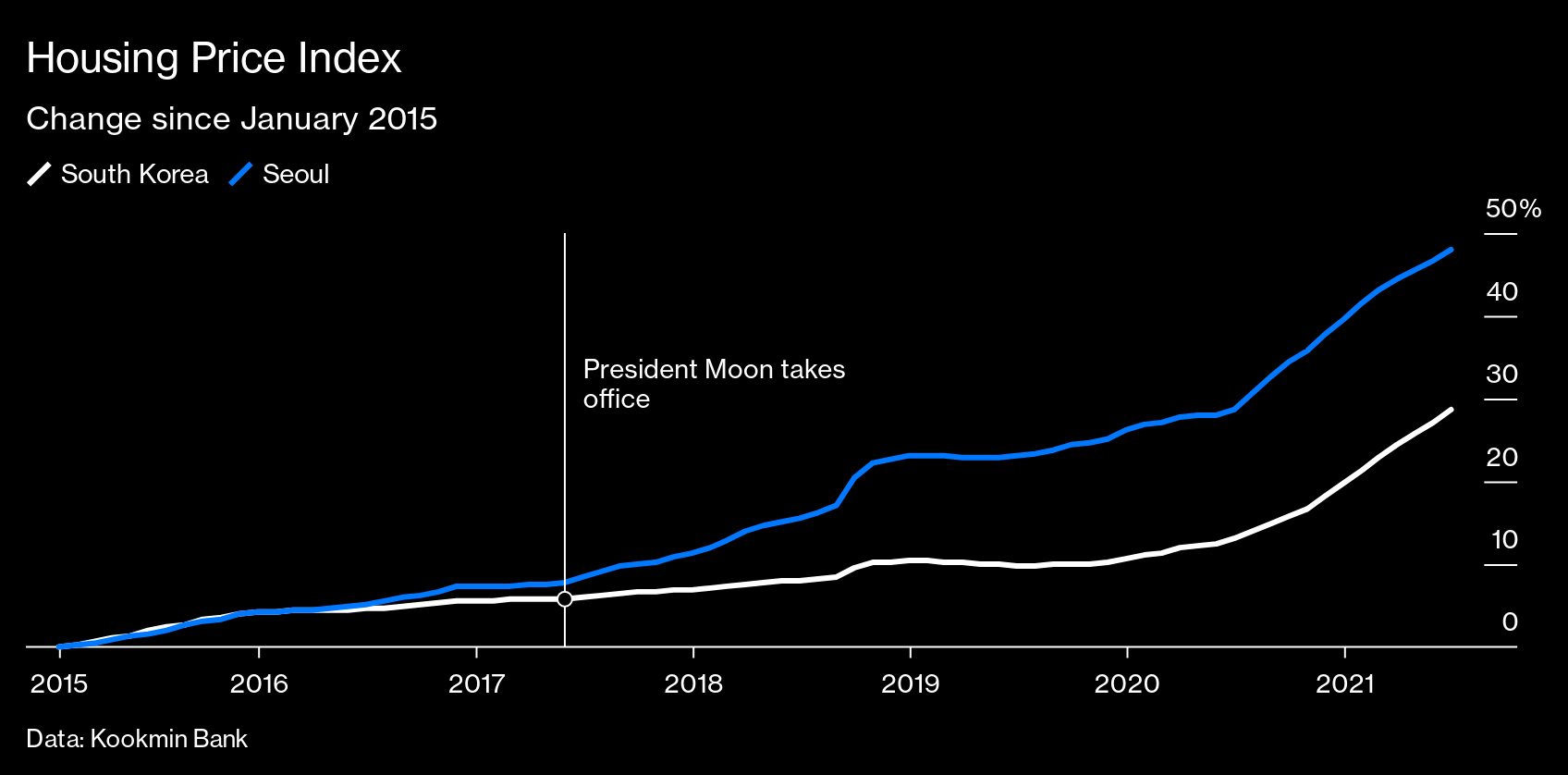
While well-intentioned, Moon Jae-In’s intervention in housing and energy markets led to rocketing costs for consumers and families. Before his election, Moon vowed to clamp down on housing speculation and real-estate investment funds that were artificially inflating housing demand and thus pushing prices higher. Following his election, Moon’s Democratic Party focused on legislation to curb demand by restricting loans, neglecting the supply side of the housing market that needs to be boosted to reduce house-price inflation. Moon failed to close the real estate loopholes exploited by investors, instead hurting low-income individuals by curbing their demand. The combination of tighter restrictions for borrowing for lower-middle income households, and a failure to institute incentives for the private sector to boost the supply of new homes, led to pent-up demand, benefitting investment funds that continued to accelerate house-price inflation. Only in 2021 did the Democratic Party begin to adopt policies that focused on increasing the housing supply as a pose to attempting to curb demand. By this time, the damage had already been done.
Moon’s energy policies have similarly been a total disaster. The Democratic Party promised to end nuclear power upon arrival in 2017, appeasing the far-left of the party. Nuclear energy’s stake started to decline rapidly following the introduction of legislation to curb nuclear production, from 30% in 2016 to 23% by 2018. This resulted in spiking electricity charges as electricity is a substitute for nuclear energy, leaving the Korean Electric Power Corporation with its largest ever deficit of $15.8 billion in 2021. A catastrophic failure for everyone involved, restricting energy production led to Korea becoming more dependent on foreign energy sources, especially Russia.
This left Korea forced to continue importing crude oil and coal from Russia following the latter’s devastating invasion of Ukraine in 2022. Had Moon pursued an agenda of increasing nuclear energy production while adopting the lessons from the Fukushima accident of the decade’s start, Korea would’ve continued on a sustainable path to energy independence.
Taxation & Spending
Alongside the housing above and energy policy failures, Moon Jae-In’s policy failures on taxation and government spending further hurt the Korean economy. The Democratic Party pursued a policy of raising taxes for businesses and increasing regulations, raising the corporate tax rate from 22% to 25%. This policy was more damaging for the Korean economy than most due to the influence of chaebols in the Korean economic and political processes. This is because higher corporation taxes punish small businesses, in particular, who don’t have the means to absorb the higher costs or avoid the tax as most large companies do. As such, this further exacerbates the oligopoly problem in many Korean industries by restricting competition. Fewer companies can compete with the mega-corporations in many Korean sectors due to the additional costs that high business taxes and regulations provide.
With this said, some positive developments did occur with the Moon Presidency. Higher taxes on tobacco and alcohol contributed to a continued decline in usage, promoting healthier outcomes by attributing the increased revenue to boosting funding for one of the best healthcare systems in the world (discussed in a previous article). Cutting taxes and introducing tax credits for low-income earners, alongside increasing deductions for childcare and education costs, helped offset some of the adverse effects of raising taxes on businesses, keeping individuals keep more of their hard-earned money and returning more money to private sector hands.
However, on aggregate, given that more resources were being allocated by the less efficient public sector, which Korea has historically successfully avoided, Moon Jae-In’s fiscal policy agenda cannot be touted as a success.
Ultimately, Moon Jae-In’s economic legacy as President wasn’t a success. Rocketing housing costs through misguided fiscal policies that focused on the demand side as a pose to supply hurt hard-working families by pushing up mortgage costs in the short term and rents in the long term. Similarly, the move to increased energy dependence through restricting nuclear has contributed to the inflation crisis of today, with energy-independent countries such as Switzerland not suffering from these higher costs. Finally, excessive government intervention through raising business rates and regulations has penalised SMEs, further contributing to the consolidation of chaebols at the top of the Korean economy.

 Free Marketeer